Banana Biscoff Cake
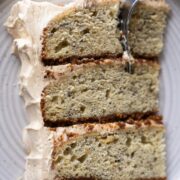
This Banana Biscoff Cake features three moist banana cake layers on a crunchy Biscoff cookie crust, all frosted with a rich and creamy Biscoff buttercream.
Servings 12 slices
Ingredients
For the Crust
- 30 whole Biscoff cookies pulsed to a powder in a food processor
- ½ cup unsalted butter melted
- ⅓ cup granulated sugar
For the banana cake layers:
- 3 cups all-purpose flour
- 2 teaspoons baking powder
- 1 teaspoon baking soda
- 1 teaspoon salt
- 1 cup unsalted butter room temperature
- 1 Tablespoon vegetable oil
- 1½ cups granulated sugar
- 4 large eggs room temperature
- 1 cup buttermilk room temperature
- 1 teaspoon vanilla extract
- 4 medium-sized or 3 large ripened bananas mashed
For the Biscoff Frosting
- 2 cups unsalted butter room temperature
- 3 cups cookie butter spread
- 5 cups powder sugar
- 3-4 tablespoon heavy cream
- 1 teaspoon vanilla
- ¼ teaspoon salt
Instructions
For the Biscoff Crust
- Preheat your oven to 375°F. Spray three 8-inch round cake pans with non-stick cooking spray. Line the bottoms with parchment paper, then spray again to ensure the cakes release easily. Set aside.
- In a food processor, blend your biscoff cookies until a fine crumb.
- In a medium mixing bowl, combine the Biscoff cookie crumbs, melted butter, and granulated sugar. Using a rubber spatula, stir the mixture together until all of the crumbs are evenly coated in butter.30 whole Biscoff cookies pulsed to a powder in a food processor, ½ cup unsalted butter melted, ⅓ cup granulated sugar
- Continue mixing until the texture resembles wet sand. When you squeeze a small handful of the crumbs in your hand, the mixture should hold together and not fall apart.
- Divide the mixture evenly between the three prepared cake pans (about 4 ounces per pan if using a kitchen scale or 1 cup).
- Using the bottom of a measuring cup or flat glass, press the crumbs firmly into the bottom of each pan to create an even crust layer. Make sure the crust is packed tightly so it holds together once baked.
- Bake for 5–7 minutes, or until the crust is lightly golden and fragrant.
- Remove the pans from the oven and allow the crusts to cool while you prepare the banana cake batter.
For the Banana Cake:
- Reduce the oven temperature to 325°F.
- In a medium bowl, whisk together the all-purpose flour, baking powder, baking soda, and salt until evenly combined. Set aside.3 cups all-purpose flour, 2 teaspoons baking powder, 1 teaspoon baking soda, 1 teaspoon salt
- In another bowl, mash the ripe bananas using a fork until mostly smooth with only small lumps remaining. Set aside.4 medium-sized or 3 large ripened bananas mashed
- In the bowl of a stand mixer fitted with the paddle attachment, add the butter, vegetable oil, and granulated sugar. Mix on medium-high speed for about 5 minutes, until the mixture becomes light in color and fluffy in texture.1 cup unsalted butter room temperature, 1 Tablespoon vegetable oil, 1½ cups granulated sugar
- Using a rubber spatula, scrape down the bottom and sides of the bowl to ensure everything is evenly incorporated. Reduce the mixer speed to medium. Add the eggs one at a time, mixing for about 30 seconds after each addition. Scraping the sides and bottom of the bowl with a rubber spatula after each addition4 large eggs room temperature
- Add the vanilla extract and mix on low speed until incorporated. Scrape the bowl again to make sure everything is evenly combined. With the mixer on low speed, begin alternating the dry ingredients and buttermilk.1 teaspoon vanilla extract
- Add about ⅓ of the flour mixture, mixing just until it disappears into the batter. Next, add about ½ of the buttermilk, mixing again on low until combined. Continue alternating the remaining flour and buttermilk, finishing with the flour mixture. Mix only until no dry flour streaks remain.1 cup buttermilk room temperature
- Add the mashed bananas and gently fold them into the batter using a rubber spatula. Scrape along the bottom and sides of the bowl while folding to ensure everything is evenly combined. Do not overmix. The batter should look smooth, thick, and evenly blended.
- Divide the batter evenly between the three prepared cake pans (about 20 ounces of batter per pan if using a kitchen scale).
- Using a small offset spatula, gently spread the batter so it reaches all edges of the pan and sits evenly on top of the crust.
- Bake for 30–33 minutes, or until a toothpick inserted into the center comes out clean or with a few moist crumbs attached.
- Remove the cakes from the oven and allow them to cool in the pans for 10 minutes. Run a small offset spatula or butter knife around the edges of each cake to loosen them from the pan.
- Carefully invert the cakes onto a wire rack and allow them to cool completely before frosting.
- If the cakes have domed slightly during baking, use a serrated knife to level the tops once they are fully cooled.
For the Cookie Butter Filling
- In the bowl of a stand mixer fitted with the paddle attachment, add the butter and Biscoff cookie butter spread. Mix on medium speed for 2–3 minutes until the mixture becomes smooth and creamy.2 cups unsalted butter room temperature, 3 cups cookie butter spread
- Using a rubber spatula, scrape down the bottom and sides of the bowl to ensure everything is evenly mixed. Add the powdered sugar, heavy cream, vanilla extract, and salt. Mix on low speed at first to prevent the powdered sugar from flying out of the bowl.5 cups powder sugar, 3-4 tablespoon heavy cream, 1 teaspoon vanilla, ¼ teaspoon salt
- Once the sugar begins incorporating, increase the speed to medium-high and beat the frosting for about 2 minutes, until it becomes light, fluffy, and spreadable. Scrape down the bowl once more and mix briefly to ensure a smooth buttercream.
- If the frosting seems too thick, add an additional tablespoon of heavy cream.
Assembly
- Once the cake layers are completely cool, begin assembling the cake. If needed, use a serrated knife to level the tops of the cake layers so they stack evenly.
- Place the first cake layer on a cake board or serving plate, with the Biscoff crust facing down. Add about ¾ cup of Biscoff frosting to the top of the cake. Using an offset spatula, spread the frosting evenly to the edges of the cake layer. Try to keep the frosting level so the cake stacks evenly.
- Place the second cake layer on top, again with the Biscoff crust facing down.Repeat the frosting process with another ¾ cup of frosting.
- Place the final cake layer on top.
- Using an offset spatula, spread a thin crumb coat layer of frosting over the entire cake. This helps trap crumbs and creates a smooth final layer.
- Place the cake in the freezer for 10–15 minutes so the crumb coat can set.
- Remove the cake and apply the final layer of frosting, smoothing the sides and top with an offset spatula.
- Allow the cake to sit at room temperature for about 20 minutes before slicing so the frosting softens slightly and the cake cuts cleanly.